

And what other food banks can learn from their playbook.
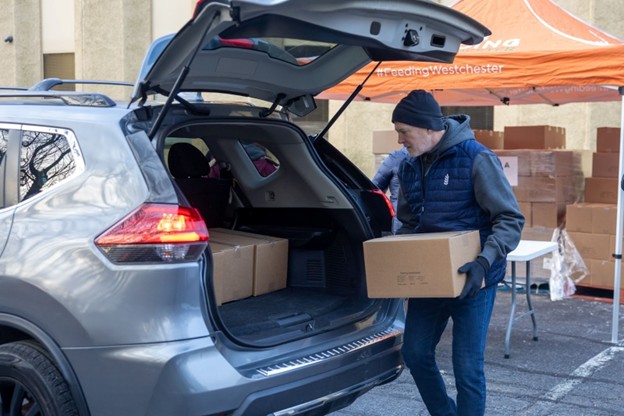
Every Wednesday morning at Feeding Westchester’s distribution center in Elmsford, New York, DoorDash drivers line up to collect boxes of shelf-stable, medically tailored food. Each driver takes ten boxes. Each box goes to a different household. Every box contains enough nutritious food for one person for an entire week covering three meals a day for seven days.
Less than a year ago, none of this existed. The program started with fewer than ten participants and a team that didn’t yet know how fast things were about to move. Today, Feeding Westchester delivers roughly 250 boxes per week, has served more than 270 neighbors ranging in age from infants to adults in their nineties, and has put over 4,000 boxes — totaling over 70,000 pounds of food so far — into the hands of Medicaid beneficiaries experiencing food insecurity.
The program is funded through New York State’s 1115 Medicaid waiver, which allows state health care plans to use Medicaid dollars to test whether non-medical interventions like nutritious food can improve public health. New York has committed $7 billion over three years to connect Medicaid members with social services, including nutrition, housing, and transportation. Feeding Westchester’s Food As Medicine program taps directly into that funding stream.
We spoke with Marissa Olson, Food As Medicine coordinator at Feeding Westchester. She manages everything from client enrollment to DoorDash logistics to Medicaid billing, about how the program works, what it took to scale, and what she’d want other food banks to know before launching their own.
How It Started
Feeding Westchester first learned of the program through a presentation by the CEO of Hudson Valley Care Coalition who is the lead of the Social Care Network that manages the 1115 Medicaid program in 5 counties, including Westchester. “With my public health background, I quickly saw an opportunity to scale up nutrition services for neighbors in need, understanding this would directly impact better health outcomes. It’s a public health dream!” says Brad Kerner, Vice President of Community Engagement and Impact at Feeding Westchester.
The program was modeled in part on an initiative in Eastern North Carolina, where the Food Bank of Central and Eastern North Carolina had successfully launched a similar Medicaid-funded food box delivery program. Because Value-Added Food Sales was the vendor for that program, much of the operational groundwork for box design, nutritional compliance, and supply logistics was in place when Feeding Westchester was ready to launch their program.
Feeding Westchester was prepared to begin distributing boxes in January 2025, when New York State began reimbursing community-based organizations for 1115 waiver services. But the first referral didn’t arrive until July. That lag underscores one of the realities of this kind of program: the infrastructure connecting healthcare systems to social services, and food as one of those social services, is still being built in most states.
How Medicaid 1115 Waiver Referrals to Food Banks Work: The Pipeline Everyone Wants To Know
One of the most common questions food banks have about 1115 waiver programs is deceptively simple: how do people actually get enrolled in the program? In Westchester, the answer involves several partners. Understanding the full pipeline process is critical for anyone considering this model.
Feeding Westchester’s program operates within New York’s Social Care Network structure. The state designated nine regional networks to coordinate screenings and referrals. In the Hudson Valley region, that role belongs to the Hudson Valley Care Coalition (HVCC), which has trained navigators at approximately 100 community-based organizations to screen Medicaid members for unmet social needs.
Here’s how a participant typically enters the program:
Step 1: A Medicaid member talks to a social worker at their healthcare provider or calls 211 through United Way and expresses a concern, such as food insecurity.
Step 2: A screener conducts an assessment to confirm their Medicaid insurance status and identify their needs. In this assessment, they may be flagged for assistance with nutrition, housing, transportation, or other services.
Step 3: A navigator works with the member to identify specific resources and connects them with the right service provider.
Step 4: The referral reaches HVCC, which conducts a final insurance verification before sending the neighbor to Feeding Westchester for enrollment in food assistance. According to Marissa, this step is not visible to the public, but it is critical in keeping the process running smoothly.
Once the referral arrives at Feeding Westchester, Marissa calls the individual to confirm their delivery address, verify that they want the nutrition service, and ensure that the shelf-stable food box is the right fit for their needs. Some participants may need prepared meals instead — perhaps they don’t have a working kitchen or the ability to cook. Those individuals get connected with a different service.
The turnaround is fast. If Marissa enrolls someone on Monday, they can receive their first delivery by Wednesday. Participants receive a box containing food for 21 meals each week for six months, after which they’re reassessed for renewal.
From 10 Clients to 100 in Two Weeks: What Scaling Actually Looked Like
The program ran as an informal pilot for roughly six months before Marissa joined the team. During that period, enrollment hovered around ten participants — small enough that one person in the office could manage everything, including calling each client individually every week.
Then things accelerated quickly as the approval process took off. “The week before I started, we had 40 participants. Two weeks after I started, we had 100,” said Marissa.
That growth exposed every manual process that had worked at a small scale. Calling 100 clients weekly was no longer feasible. “We had to reimagine the process once it started growing so quickly. As we scaled, we would find new problems and quickly figure out how to fix them,” said Marissa.
The team had to find a text messaging service. Luckily, they already had one in use for other Feeding Westchester programs. They used it to communicate delivery schedules, holiday changes, and weather delays. Marissa and team quickly connected the Medicaid 1115 waiver recipients to the text message system.
She also had to learn to forecast her box orders with almost no historical data. As they were scaling, she placed orders for full truckloads every couple of weeks, even when they didn’t know what the following week’s enrollment would look like.
What drove the surge? Marissa attributes it largely to the navigators at the Social Care Network getting comfortable with the process. Referrals accelerated as soon as they saw the proof of concept that their clients were reliably receiving food every week.
Designing the Medicaid 1115 Waiver Food Box Menu: Balancing Nutrition, Compliance, and Logistics
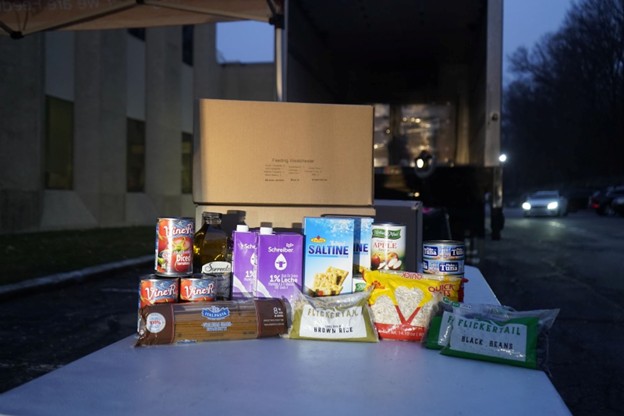
The Medicaid 1115 waiver nutrition program requires each box to meet a meal factor of 21. That means it needs to be enough food for three meals a day for seven days for one individual. Since housing and kitchen situations vary among recipients, Feeding Westchester chose to standardize on shelf-stable boxes low in sodium and sugar and high in protein and whole grains to fit a variety of medically appropriate nutrition needs. Feeding Westchester’s in-house registered dietitian helped develop the menus to ensure compliance.
Marissa shared that these boxes are meant to be used for pantry stocking or as a supplement to SNAP benefits. They provide a solid nutritional base that participants can supplement with fresh produce or proteins purchased using their SNAP benefits. Additionally, shelf-stable items ensure there’s always food in the house, every day of the week, regardless of whether the participant can access a pantry or grocery store.
Early on, the program used a single box menu. That worked fine for the first few weeks. But as enrollment grew and participants began receiving the same items in subsequent months, the feedback started coming in. Marissa shared, “The participants were grateful for the healthy eating assistance and delivery, but we started to hear from some clients who had been in the program longer that they didn’t want the same food every week.” Marissa and her team realized the feedback was an early indicator that the program needed improvement before it affected outcomes. The Feeding Westchester team quickly evolved to a four-box rotation — four different standardized menus that cycle weekly. Participants get Box A for one week, then B, C, D, and back to A. This gives variety while keeping logistics manageable.
To refine the menus, the team used two feedback channels. In the early pilot phase, they built direct relationships by calling participants after deliveries. As the program grew, they sampled the participants with phone surveys. They incorporated those responses into the design of the additional menus.
The program has also started incorporating shelf-stable yogurt as a breakfast option to rotate alongside oatmeal, still shelf-stable, but giving participants the feeling of something fresher. These kinds of adjustments matter for compliance. If participants don’t want to eat the food, the program doesn’t work.
A key nuance: each box is prescribed to an individual, not a family. Some participants are the only Medicaid-qualifying member in a multi-person household, and the box is designed to feed one person for the week. This is a common source of early confusion for participants. When there is more need in the household, Marissa first evaluates if anyone else qualifies. Some do and they get multiple boxes delivered each week. Marissa connects families with household members who don’t qualify for the 1115 waiver program with local pantries for supplemental food.
The Vendor Side: Why Speed and Flexibility Matter for a First-Time Program
Feeding Westchester chose Value-Added Food Sales (VAFS) for its box supply, the same vendor that supported the Eastern North Carolina program this initiative was modeled after. That existing relationship meant Feeding Westchester wasn’t starting from scratch on the supply side. VAFS already had experience building medically tailored, shelf-stable boxes for 1115 waiver programs, and the infrastructure to customize menus, adjust contents based on participant feedback, and importantly the ability to scale production consistently as enrollment grew.
For a program that went from 10 participants to over 100 in a matter of weeks, responsiveness from the supply side was critical. Marissa said, “There hasn’t been a singular day without an answer from VAFS to an email. And it’s not just quick responsiveness, the VAFS team is always very clear and concise, providing exactly what we need including timelines.”
When the Feeding Westchester team decided to move from one box menu to four rotating box menus based on participant feedback, they were able to get a new quote from VAFS confirmed within a week and receive the redesigned boxes within two to three weeks of packing and transit. The full cycle from initial request to add new menus to boxes in participants’ hands took four to six weeks.
“While we modeled our program after another food bank who also used VAFS, we’ve been able to customize all of our standard boxes the way that we want them, based on both the nutrition levels and what our neighbors and clients want,” said Marissa. As the program evolved and participant feedback required menu changes, having a vendor who could move quickly made a difference. “We needed a vendor who could work with us, make the supply side of the program easier, and very quickly change those contents. Everyone on the VAFS team has been extremely helpful.”
The Last Mile: How DoorDash Changed the Delivery Equation
Before DoorDash in the initial pilot phase, Feeding Westchester used its own trucks and drivers to deliver boxes. You read that right, the same fleet that handles pallets of food for 170+ partner pantries was delivering a single box to multiple households. That worked fine for the first handful to get the program started. But by the time they reached around 10 to 15 individual deliveries, the operations team said they needed a different solution.
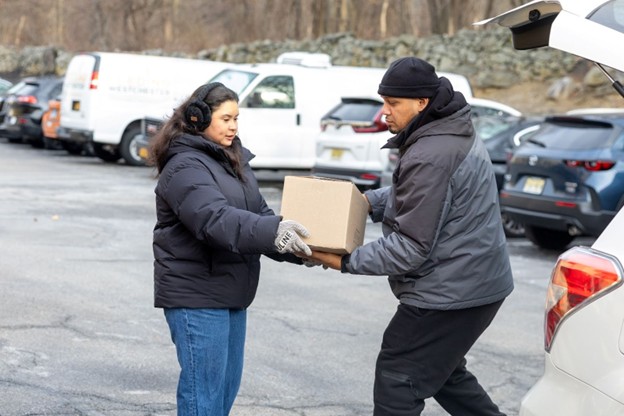
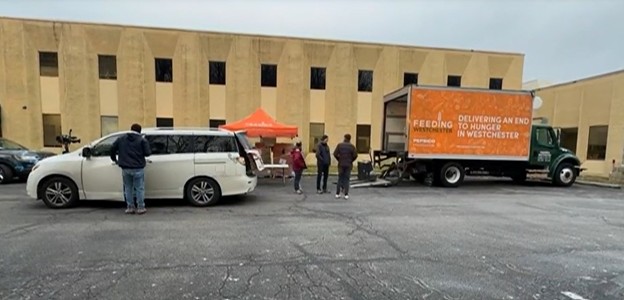
Through DoorDash’s Project DASH program, which partners with nonprofits for last-mile delivery, Feeding Westchester set up a corporate nonprofit account. Multiple DoorDash drivers come to their distribution center each Wednesday. Each driver picks up ten boxes and delivers them to individual households, earning the same rates they would for standard DoorDash orders. The food bank, however, receives a nonprofit discount rate from DoorDash. As part of the Project DASH program, Feeding Westchester also has a dedicated DoorDash account representative rather than going through standard customer service, which is an added benefit of working through the nonprofit and government relations side of the platform.
The geography works in Feeding Westchester’s favor: DoorDash’s 15-mile delivery radius covers approximately 98% of Westchester County. For one town just outside the boundary, DoorDash simply extended the radius by a mile for an additional two dollars per delivery, still cheaper than dispatching a truck or staging a secondary distribution center for that small portion of their recipient base.
Marissa’s tip for food banks in larger or more rural service areas: DoorDash supports a hub model. You can designate satellite locations like pantries, partner agencies, or even secondary warehouses as pickup points. Your internal distribution team can pre-stage the boxes at those locations prior to your client distribution day. DoorDash drivers then pick up from the closest hub to their deliveries rather than driving from a single central location. This makes the model adaptable even in most geographies where a single delivery radius won’t cover the entire food bank territory.
The Lesson Learned As The Program Matured: Renewals
When asked what she wished she’d known from the start, Marissa didn’t hesitate. “Never underestimate how long it takes to renew a Medicaid referral.”
Each participant is enrolled for six months. Renewal requires the navigator to reconnect with the client, go through the screening process again, and resubmit through HVCC. Feeding Westchester’s first renewals took longer than expected, creating service gaps for participants who still qualified.
Feeding Westchester refined their approach to the renewal cycle. They now flag participants approaching their six-month mark and initiate the process early enough to aim for uninterrupted delivery.
The Operational Reality: What It Actually Takes to Run This
In the initial pilot phase, the existing Feeding Westchester team managed the program. But as soon as they had proof of concept beyond the first handful of clients, they created a part-time position specifically to manage this program. The position is funded by state capacity-building dollars. Marissa’s role is split roughly evenly between two functions: client management (enrollment, communication, coordination with HVCC) and Medicaid billing, with much less time needed for the supply and delivery side of the program.
Medicaid billing is the most time-consuming part. Each delivery requires a proof-of-delivery invoice uploaded to the Medicaid system, including the DoorDash delivery photo showing that the box was delivered to the correct address. Invoicing approximately 240 clients individually each week takes about a full day of Marissa’s time.
Impact: What They’re Seeing So Far
Feeding Westchester hasn’t yet conducted a formal outcomes assessment — the program is still relatively young. But the qualitative signals are strong.
Participants regularly call or leave voicemails expressing gratitude. Some have called to say they no longer need the service. They’ve gotten a new job, their situation has changed, and they’re back on their feet.
By the numbers:
- More than 270 neighbors served, ages ranging from infants to individuals in their 90s.
- Over 4,000 boxes delivered, totaling over 70,000 pounds of food so far.
- Weekly delivery volume of approximately 250 boxes and growing.
- Net new enrollments of roughly 7–10 per week, with a similar number cycling off as their eligibility ends.
- HVCC fully covers program costs through the claims reimbursement. The reimbursement is also timely and reliable, a meaningful distinction for food banks accustomed to operating on grants and donations.
What Marissa Would Tell a Food Bank Starting from Scratch
We asked Marissa what she’d say to a food bank considering launching Medicaid 1115 waiver nutrition programs for the first time, and wondering where to begin. Her answer focused on the operational realities that aren’t in any policy document:
- Invest in the pilot. The first few months are slow and process-heavy. Use that time to work out the kinks — the Medicaid paperwork, the care network relationships, the delivery logistics, the box ordering cadence. All that upfront work becomes repeatable once it’s done, making it very easy to scale.
- Don’t be afraid to start small. The pilot is the proof of concept. It’s where the navigators learn to trust the system, where you learn to trust your partners, and where you build the operational muscle to scale when referrals come in.
- Budget for Administrative Work: Budget for the administrative burden of enrollment and Medicaid billing from the start. It doesn’t decrease as you scale; it grows proportionally. Medicaid reimbursement requires individual proof-of-delivery invoicing. At scale, this is a significant time commitment and potentially the bottleneck for the entire program. Feeding Westchester is actively testing solutions to streamline this process.
- Choose your vendors carefully. Your vendor relationships are one of the critical infrastructure decisions you’ll make. A program that grows from pilot to hundreds of weekly deliveries needs a supply vendor that can turn around custom menu changes quickly, scale production on short notice, and provide consistent quality and delivery timelines.
The same holds true for your delivery vendor. You need a partner that can scale quickly, provide proof of delivery, work with your timeliness and delivery areas, and be reliable. The box supply and delivery should be the parts of this program that you don’t have to worry about. You will need to focus on the enrollment, billing, and internal logistics that demand your attention.
- Plan for Direct Client Communication: The text messaging system has also become an essential part of the infrastructure. Beyond weekly delivery reminders, Feeding Westchester used the text messaging system to handle schedule changes, including holiday weeks, weather delays, and double-delivery notifications. And it serves an unexpected secondary purpose: it opens a communication channel that participants use to provide feedback and ask questions.
- Plan for growth you can’t predict. Feeding Westchester went from 10 to 100 in two weeks. Your vendor, your delivery partner, and your internal processes all need to be able to absorb that kind of acceleration.
- Build the renewal process before you need it. Don’t wait until participants start hitting their six-month mark to figure out how renewals work. Build your renewal process before you need it. Know exactly what the timeline looks like, who initiates it, and how far in advance you need to start. Participants who need this program at month one will probably still need it at month seven.
ABOUT FEEDING WESTCHESTER
Feeding Westchester is a Feeding America member food bank based in Elmsford, New York, serving Westchester County, where more than 1 in 3 households are at risk of hunger. The organization works with more than 175 partner programs, including 170 food pantries and soup kitchens that receive nearly 250,000 visits per month. In addition to traditional food distribution, Feeding Westchester has expanded into innovative delivery programs, including its Medicaid-funded Food As Medicine initiative and a federal employee food assistance program activated during the government shutdown.
INTERESTED IN Food As MEDICINE BOX PROGRAMS?
Value-Added Food Sales has supported Food As Medicine programs across the country, providing custom-designed, shelf-stable, medically tailored food boxes built to meet 1115 waiver nutritional requirements. Whether you’re exploring a new program or looking to scale an existing one, our team can help you design menus, manage supply, and get boxes to your door. Contact us at valueaddedfoodsales.com to start the conversation.